How to write 了
Animated Stroke Order of 了
Learn to write the Chinese character "了" by watching the stroke order animation of "了".
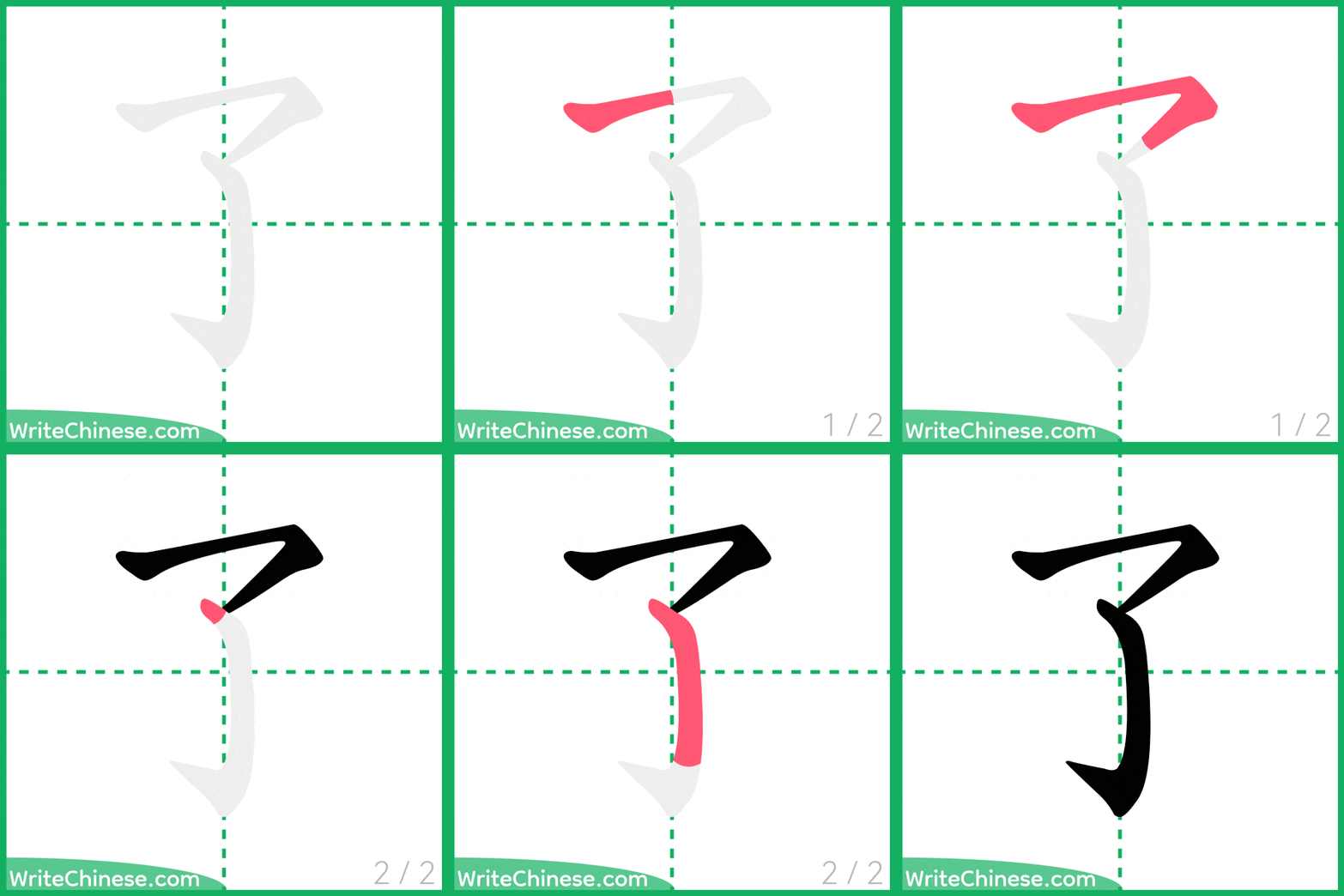
Stroke by Stroke: 了 Writing Order
Master the Chinese character '了' stroke by stroke with visual step-by-step instructions.
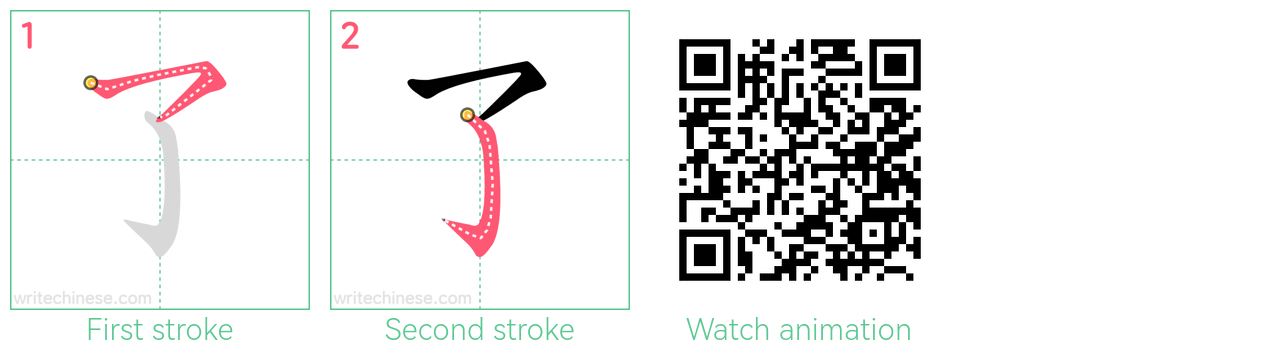
Follow the Calligraphy Master: Writing '了' Step-by-Step
Learn the proper way to write the Chinese character '了' through a video tutorial with a calligraphy teacher. Follow the Calligraphy Master's Step-by-Step Guide to Write the Chinese Character '了'. You can download the printable handwriting worksheets below and practice writing together with pen and paper.
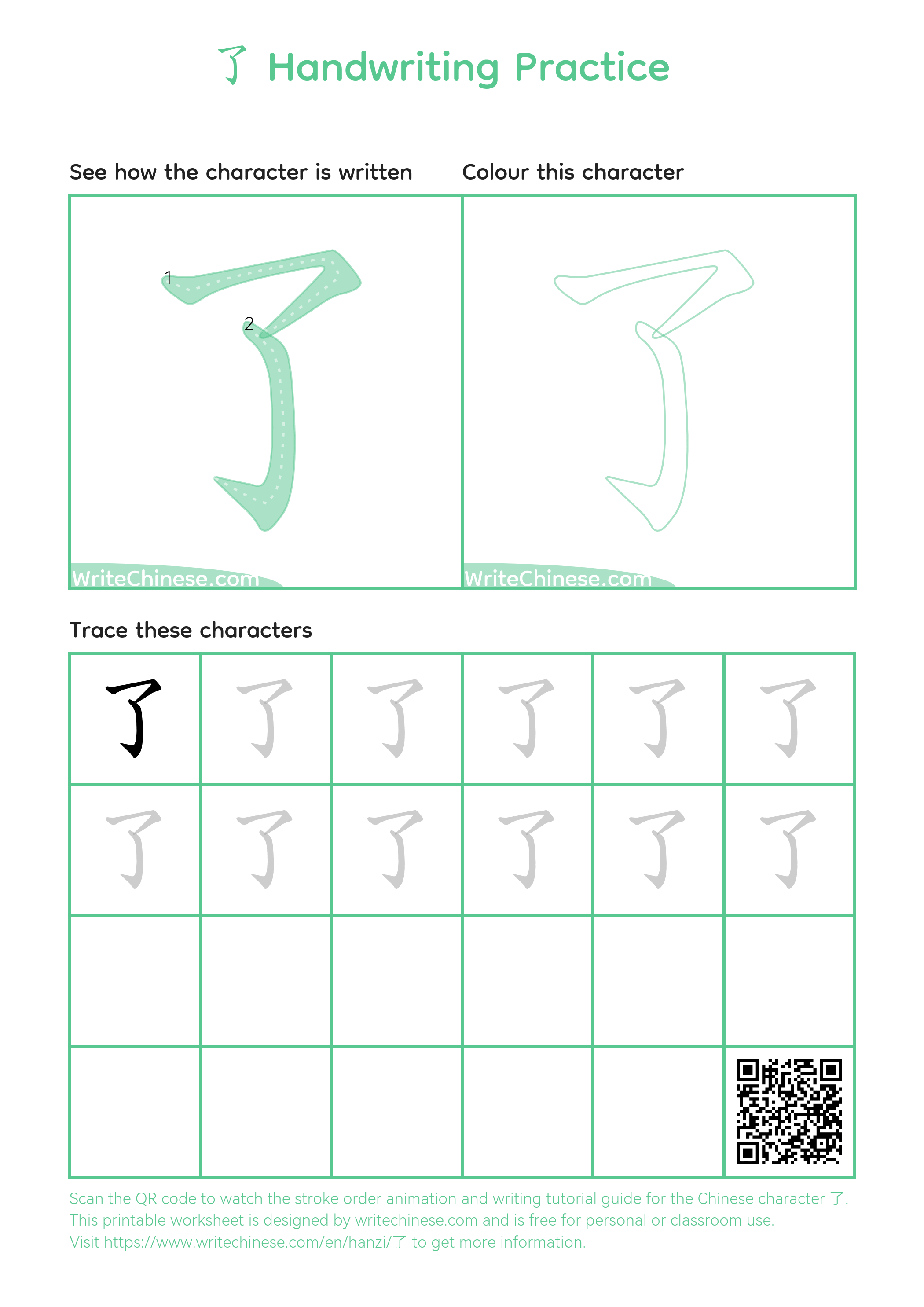
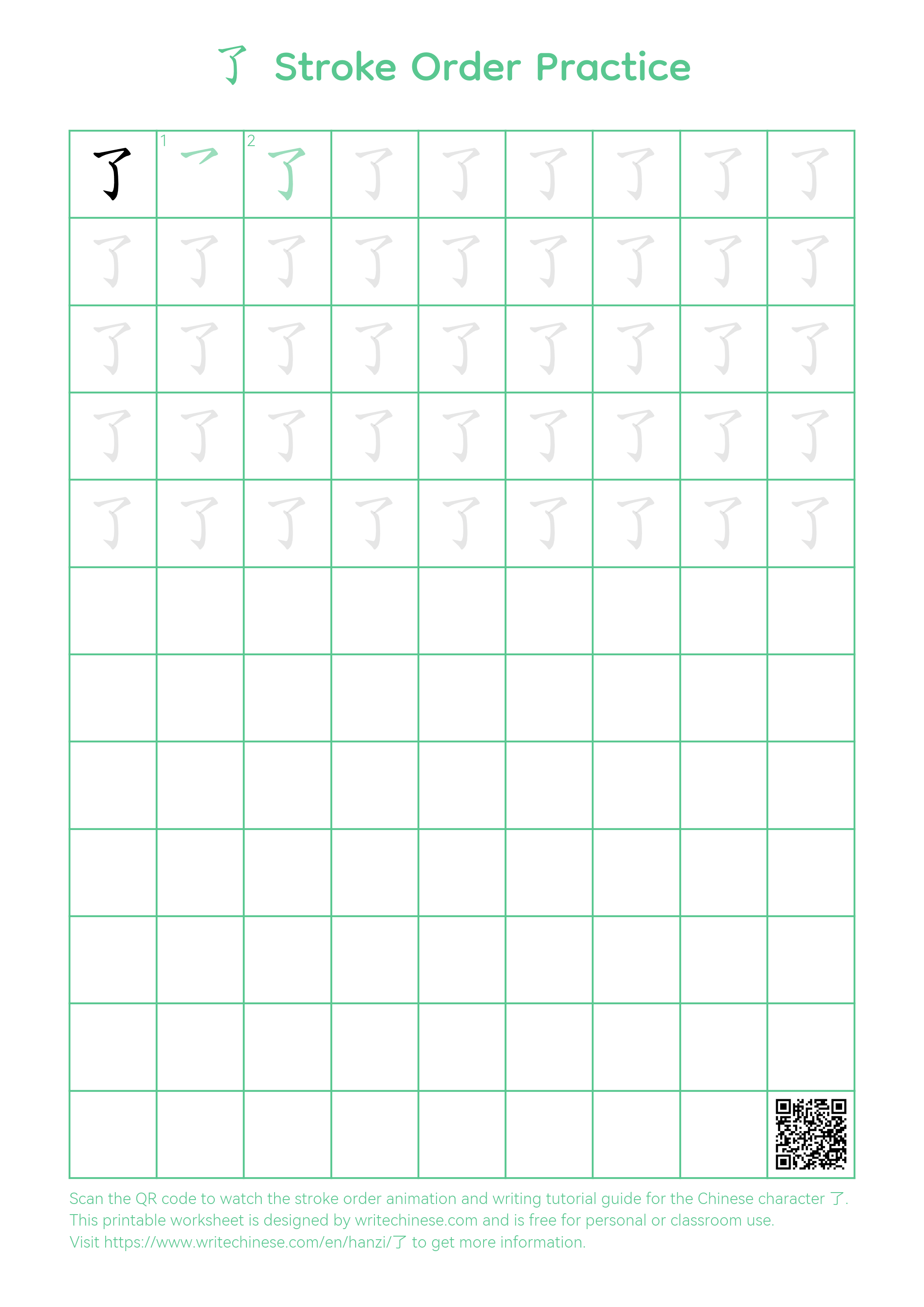
Free Printable 了 Handwriting Practice Worksheets
Meaning of 了
Pinyin
le、 liǎo
Radical
乙
Strokes
2
Definition
(modal particle intensifying preceding clause) / (completed action marker), to know / to understand / to know, clear, look afar from a high place
Usage
★★★★★
了 [liǎo]
1. 明白,知道。 (Understand, know.)
2. 完结,结束。 (Finish, end.)
3. 在动词后,与“不”、“得”连用,表示可能或不可能。 (Used after a verb, in conjunction with "not" or "can," indicating possibility or impossibility.)
4. 与“得”、“不得”前后连用,表示异乎寻常或情况严重。 (Used with "can" or "cannot," indicating unusual circumstances or serious conditions.)
了 [liǎo]
1. 明白,知道:明~。一目~然。 (Understand, know: clear at a glance.)
2. 完结,结束:完~。~结。 (Finish, end: completed it.)
3. 在动词后,与“不”、“得”连用,表示可能或不可能:看不~。办得~。 (Used after a verb with "not" or "can," indicating possibility or impossibility: cannot see it. Can do it.)
4. 与“得”、“不得”前后连用,表示异乎寻常或情况严重:那还~得!(Used with "can" or "cannot," indicating unusual circumstances or seriousness: that cannot be doubted!)
了 [liǎo]
(Verb)
本义:束婴儿两臂 (Original meaning: bind a baby’s arms.)
造字法:象形。从子,无臂。小篆字象婴儿束其两臂形。初生的婴儿,往往束其两臂而裹之。 (Character formation: pictographic, depicting a child without arms. The small seal script resembles an infant wrapped with arms bound. Newborn infants are often wrapped with arms bound.)
1. 手弯曲 (Hand bent.)
2. 假借为“憭”、“悟”。懂得,明白其意思 (Borrowed for “to understand.” Comprehend, grasp the meaning.)
3. 结束,了结 (End.)
了 [liǎo]
(Adjective)
1. 聪敏,颖慧 (Wise.)
2. 清楚,明晰 (Clear.)
3. 明亮,光亮 (Bright.)
了 [liǎo]
(Adverb)
1. 完全,全然——与“无”、“不”连用,用在动词或形容词前面,表示范围,相当于“完全(没有)”、“完全(不)” (Completely; with “none” or “not,” used before verbs or adjectives to indicate scope, equivalent to “entirely (none)” or “entirely (not)”).
2. 放在动词之后,与“得”或“不”连用,表示可能 (Used after a verb as a complement with “can” or “not” to indicate possibility or finality.)
3. 另见 le (Also see: le.)
了 [liǎo]
(Verb)
1. 放在动词或形容词后,表示动作或变化已经完成。 (Placed after a verb or adjective, indicating action or change has been completed.)
2. 助词,用在句子末尾或句中停顿的地方,表示变化,表示出现新的情况。 (Particles used at the end of a sentence or at pauses, indicating change or the emergence of new situations.)
了 [le]
(Particle)
用在动词或形容词后,表示完成 (Used after the verb or adjective to indicate completion.)
了 [le]
(Tone)
1. 表示肯定语气 (Indicates future certainty.)
2. 表示促进或劝止 (Indicates prompting or stopping.)
3. 表示感叹语气 (Indicates interjection.)
4. 另见 liǎo (Also see: liǎo.)
了 [le]
(Particle)
用在动词或形容词后,表示完成 (Used after the verb or adjective to indicate completion.)
例:如:我已经问了老王;人老了,身体差了;头发白了;这双鞋太小了 (Examples: I have already asked Lao Wang; people grow old, health deteriorates; hair turns white; these shoes are too small.)
了 [le]
(Tone)
1. 表示肯定语气 (Indicates future certainty.)
例:如:明天又是星期六了;要过新年了,人们都很高兴 (Examples: Tomorrow is Saturday again; New Year is coming, people are very happy.)
2. 表示促进或劝止 (Indicates prompting or stopping.)
例:如:快躲了;别吵了!闪开了! (Examples: Hurry and hide; stop making noise! Step aside!)
3. 表示感叹语气 (Indicates interjection.)
例:如:好了!别闹了! (Examples: Alright! Stop messing around!)
4. 另见 liǎo (Also see: liǎo.)
having given away a bride, to lose one's army on top of it (idiom) / to suffer a double loss after trying to trick the enemy
lit. if you can't eat it all, you'll have to take it home (idiom) / fig. you'll have to take the consequences
Distant water cannot quench present thirst / Slowness can not meet hasty demand. / The aid is too slow in coming to be of any help.
Correct! / Oh, that's right, ... (when one suddenly remembers sth one wanted to mention) / Oh, by the way, ...
Same Pronunciation Characters
Same Radical Characters
Easier Access
No need to remember the website address or type any Chinese characters. Simply scan the QR code
for easier access to this page. Alternatively, you can quickly access this page by clicking to
copy and paste the URL.
Input Method for 了
Pinyin
le5
Wubi
bnh
Cangjie
nn
Zhengma
y
Four Corner
17207
Unicode
U+4e86
Stroke Number Category
HSK Level Category